Choosing a Sofa: What to Look for in Singapore
Some sofas arrive looking generous on a showroom screen and become uncomfortable the moment you sit down. The issue is rarely appearance alone. It can be seat depth, foam density, cushion height, armrest shape, fabric stretch, or a frame that offers little support. In a compact Singapore home, those details matter twice because the sofa must work for residents, guests, and sometimes a weekend nap.

Budget under1000 is a practical target for many households furnishing an HDB flat or condo in Tampines, Bedok, or Punggol. A quoted price below SGD 1,000 is only useful if the sofa's dimensions, construction, comfort, and delivery conditions are clear. GST should also be shown separately, because a listed price before GST may not remain under1000 after tax.
This guide explains how to assess a sofa without relying on photographs or sales language. It also covers the route to sofa repair, the measurements needed for a bed frame, and the design differences behind French light luxury, American light luxury, and post-modern light luxury.

What should I check before buying a sofa for everyday use?
Start with the position from which you will actually use it. Measure your normal seat height at home, usually between 40 cm and 45 cm from the floor. Ask the seller for the finished seat height, the usable seat depth, the internal seat width, and the backrest angle. A sofa with a nominal width of 180 cm may have only 150 cm of usable width after both arms, so two adults may still feel crowded.
Next, test the seat rather than merely pressing it once. Sit for at least 3 minutes with your back against the cushion and your feet on the floor. Lift the front edge by about 5 cm and release it. The cushion should recover without taking more than roughly 10 seconds, although this is a simple observation rather than a laboratory test. Check whether your thighs feel supported, your shoulders feel open, and your lower back remains in a comfortable position.
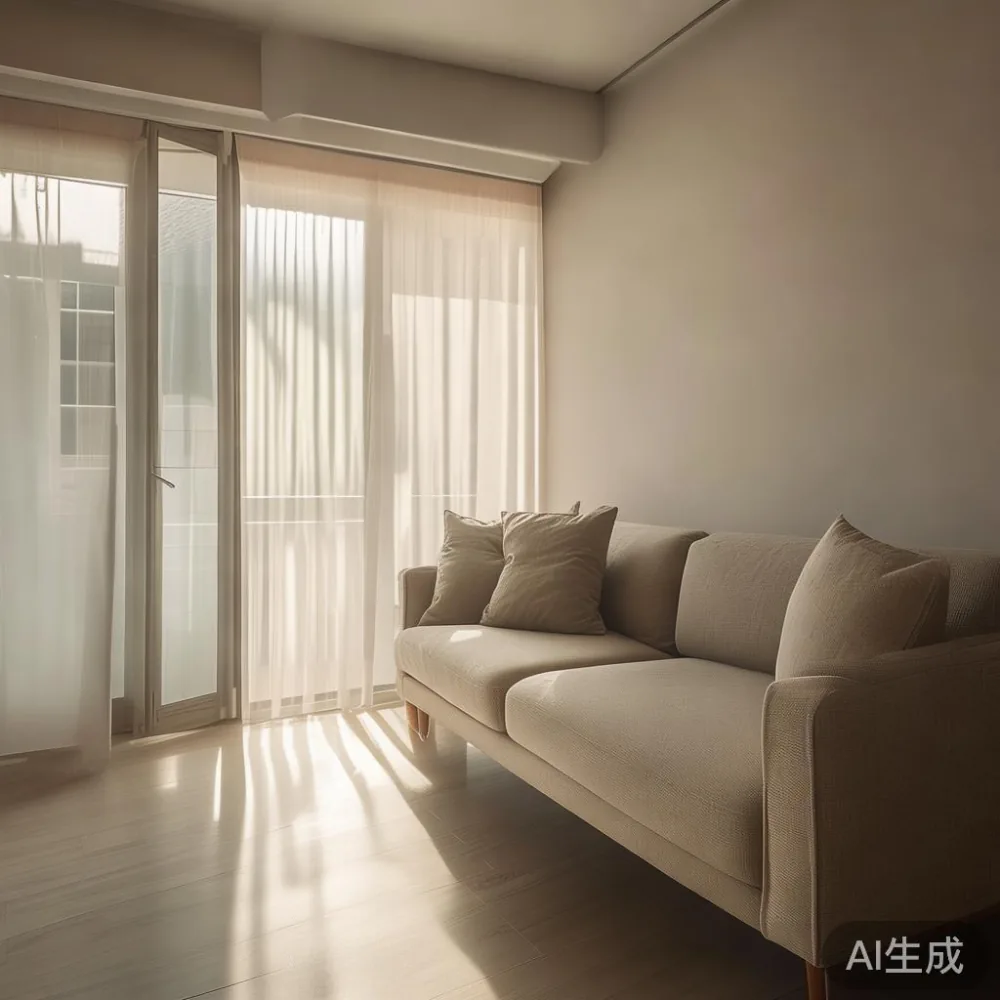
Height matters more than many buyers expect. A seat that is 38 cm high can feel low after dinner. A seat that is 48 cm high can make an older adult feel as though they are perched. Look for a firm cushion that supports rather than collapsing, with a surface you can compress by about 3 cm to 5 cm under your weight. Loose back cushions can make a sofa look deeper than its fixed seat, so mark the intended sitting position and measure there.
Armrests also affect the usable width. Deep, rolled arms can take away 10 cm to 15 cm per side, while slim or track-style arms preserve more seating space. In an HDB living room, a 160 cm sofa may be more practical than a 200 cm model, but only if the minimum seating width is acceptable. Confirm the sofa's complete footprint, including the arms, and allow at least 60 cm for a circulation route in front when people pass regularly.
Request the frame information in writing. Look for kiln-dried hardwood, plywood, or another documented structural material, with joints fixed by screws, corner blocks, or brackets rather than only staples. Avoid a seller who cannot identify the frame material. For a solid wood sofa, distinguish the visible timber from the structural frame, and ask whether the back and seat supports are solid wood, plywood, or metal.
Consider the cushion fill as a comfort system rather than a single feature. High-resilience foam often provides a firmer starting feel, while fibre wrapping or a feather-like top layer can soften the surface. Ask about the foam density and the thickness of each layer. A useful reference is around 35 kg/m³ to 45 kg/m³ for a firmer seat foam, although the complete cushion design still determines how the sofa feels.
Last, examine the covers and warranty. If you expect to clean the sofa often, ask for removable and washable covers, the care instructions, and the expected shrinkage after washing. The structural warranty should state which components are covered and for how many years. MIDHILL offers a 10-year structural warranty and lifetime refinishing, but you should still confirm how service is handled in Singapore and whether lifetime refinishing applies to the specific finish and product shown.
How long should delivery and assembly take?
Ask for the delivery lead time at checkout, not just a general estimate. A Singapore order might take 7 to 14 delivery days for an in-stock configuration, while a made-to-order sofa can take 6 to 10 weeks. Custom upholstery or unusual dimensions can add another 1 to 3 weeks. These ranges explain why a quotation should include the estimated date, the carrier, and the service charges.
For furniture headed into an HDB flat, the building's delivery rules can affect the final day. Reserve a loading-booking slot if required, and measure the route from the service lift to the lift doors. Common residential lift door widths are around 80 cm to 90 cm, but older blocks vary. The lift car's internal dimensions and turning space matter just as much as the entrance.
Measure the sofa's largest shipping carton as well as the assembled piece. A 190 cm sofa may fit into the flat after assembly but arrive in a carton too large for the lift. Ask for carton length, width, height, and weight. A three-seat sofa may weigh between 55 kg and 95 kg, so the delivery crew should know whether a hoisting service is needed.
Corridor widths can be tighter than living-room space. Check any turn near the flat entrance, the corridor pinch points, and the width of your own door. If a sofa arm is 12 cm and the corridor narrows to 76 cm, the arm may need temporary removal. Confirm whether the supplier's delivery team includes carrying upstairs, unpacking, assembly, and packaging removal.
Also confirm the return process. A 14-day returns policy gives buyers room to compare a delivered sofa with the room's dimensions and lighting. Ask whether the sofa must be unused, whether original packaging is required, and who pays the return freight. These details can decide whether a seemingly affordable sofa is genuinely practical.
What does “French light luxury” mean for a sofa?
French light luxury is not one fixed construction method. It usually describes a restrained mood: graceful profiles, balanced proportions, pale upholstery, occasional timber details, and decorative touches that feel composed without looking ornate. A solid wood sofa with a light oak or ash frame, slim arms, and tailored cushions can fit this style when its shape remains neat rather than heavily carved.
The phrase French sofa vs French provincial sofa is useful when comparing product labels. A French sofa may refer broadly to a French-inspired design, while French provincial styling often carries more visual cues such as shaped arms, turned legs, softer upholstery, or carved-looking details. The name alone does not establish comfort or quality, so examine the frame and cushion specification independently.
For modern French provincial furniture, check whether the decorative elements are balanced by good proportions. Curved arms and tapered legs can work in a compact condo, provided the actual seat depth and arm clearance are stated. A French-inspired look should not cause you to accept an undersized frame or a seat that is too soft for daily support.
American light luxury often leans toward a broader, more architectural silhouette: clean lines, low profiles, substantial upholstery, and a stronger sense of scale. This can suit a larger living room, but a 220 cm model in a narrow HDB living area may restrict circulation. Post-modern light luxury may combine familiar forms with simplified details, which can be useful when you want visual character without a heavily themed room.
One phrasing that appears in some catalogues is modern Modern light luxury furniture. Treat that wording as a style direction, not a performance claim. Ask for measurable facts: frame material, cushion density, seat height, dimensions, finish, and warranty. Style can shape the room; construction determines whether you will want to sit on the sofa for 3 years or 10.
MIDHILL's post-2008 experience and export work across more than 15 countries are relevant background, but they do not replace a product-specific inspection. Check the sample, joinery, finish, and care guidance for the exact sofa you are considering.
How do I plan a bedroom around a bed frame?
Choose the bed frame by measuring the room and the route into it, not by starting with a decorative finish. For a standard Singapore queen mattress, the mattress is usually about 152 cm by 191 cm. A queen frame may therefore need an footprint of 158 cm by 205 cm, depending on the headboard and side rails. Check the mattress supplier's exact dimensions before ordering.
Leave a passage of roughly 60 cm beside a bed where possible, and maintain enough space at the foot for a person to stand and pull back the covers. A headboard against the wall can save 6 cm to 10 cm compared with a freestanding model. In an HDB bedroom, sliding-door wardrobes may already occupy much of the wall, so the remaining opening needs careful measurement.
The European bed vs Nordic bed comparison is partly about visual weight and partly about construction. European-style beds may feature upholstered heads, shaped frames, or decorative profiles. Nordic-style beds commonly emphasize light timber, simple lines, and visible joinery. Neither category tells you whether the joints, centre support, and slats are properly engineered.
Ask whether the slat spacing is compatible with the mattress. For foam or hybrid mattresses, close support can prevent early sagging. Confirm the centre support, leg dimensions, and total load rating. If the bed is for two adults, look for a stated dynamic load of at least 250 kg per side rather than relying on a broad “heavy-duty” label.
For finish planning, how to style Japandi bed in bedroom is largely a matter of proportion, texture, and restraint. A light oak or ash bed frame can pair with plain bedding, one low platform, and a simple paper or fabric shade. Keep the surrounding furniture visually quiet so the bed does not look crowded against a sliding wardrobe.
The Japanese bed vs Japandi bed distinction is similarly subtle. A Japanese bed may refer to a floor-level sleep system, while Japandi blends Japanese simplicity with Scandinavian warmth. If a low platform is only 20 cm to 30 cm high, assess whether it suits the occupants' mobility and whether the room still supports storage.
A related project may include a dining table, wardrobe, nightstand, or marble table. These are complements to the bedroom rather than distractions: the dining table needs 90 cm of clearance behind each seated position, a wardrobe door needs space to open fully, and a marble table should be checked for weight, edge treatment, and delivery access.
Can a sofa be repaired after delivery?
Yes, if the supplier offers post-sale service and the issue falls within the stated terms. Before delivery, ask for the repair contact, response time, and common spare-part availability. For example, confirm whether cushion covers, foam, legs, drawer runners, and care products are stocked in Singapore. A 5 to 10 business-day repair estimate is reasonable for a routine part, although more complex frame work can take 4 to 8 weeks.
Keep photographs of the sofa at delivery. Capture the front, back, arms, seat, frame underside if accessible, and the packaging label. Record any damage in the delivery paperwork on the day of receipt. Scratches, loose joints, or shifted legs should not be left for later discovery.
Ask whether the frame can be disassembled. A sofa with detachable legs and separate seat modules is easier to carry through a lift than a fixed frame with a 180 cm arm-to-arm body. Reassembly should not weaken the joints. If the finish is damaged, request a repair quotation rather than assuming every mark can be concealed with a cushion.
MIDHILL's lifetime refinishing policy is worth comparing with the seller's service terms, but read the conditions attached to the specific item. Finish life varies with sunlight, humidity, pets, and cleaning methods. In Singapore, keep the sofa away from a west-facing window with direct afternoon sun where possible, and maintain indoor relative humidity around 50% to 65% when practical.
For a solid wood sofa, check whether the visible finish is lacquer, oil, or another coating, and request the corresponding care instructions. Oiled timber may need periodic maintenance. Lacquered timber may need less frequent attention but can show scratches differently. These care requirements should be understood before the sofa enters a busy family home.
Will a sofa below SGD 1,000 fit both my budget and my flat?
It can, provided the full cost and fit are confirmed. Build a comparison sheet using the final price including GST, delivery, assembly, lift-hoisting fees, and any optional fabric upgrade. If a sofa is listed at SGD 899 before GST, the total with 9% GST is SGD 979.91. Delivery may add another SGD 30 to SGD 80 within a standard Singapore location, while a difficult lift may cost more.
That arithmetic keeps the budget under1000 realistic only if the sofa price leaves room for access charges. Ask for the complete payable amount in writing. Also check whether the seller applies GST to the delivery component and whether the stated threshold for free shipping over US$350 has any relevance to the Singapore transaction; do not assume an international shipping promise settles local access costs.
For dimensions, photograph the sofa's placement area and sketch the route from the lift. Enter the sofa's true depth, usually 85 cm to 100 cm for many three-seat models. If your coffee table leaves only 35 cm between its edge and the sofa, circulation will feel tight. Moving the table 10 cm or choosing a slim sofa arm can preserve comfort without changing the entire room.
Check the seat with at least 2 people present if possible. One person can judge the seat height while another observes whether two people have their own defined sitting space. A showroom may also feel larger because it has high ceilings and generous lighting. Bring a floor plan, a tape measure, and the names of the household members who will use the sofa most often.
Ask for a fabric swatch and, where available, a physical or clear visual sample. Test the colour under your flat's evening lighting as well as daylight. If pets or children are likely, compare stain resistance, seam construction, and removable-cover availability. A soft neutral can work in French light luxury, American light luxury, or post-modern light luxury, but the fabric specification matters more than the style label.
Finally, compare service, not just sticker price. A clear 10-year structural warranty, defined returns process, access to replacement parts, and an answer to repair questions can make two similarly priced sofas very different purchases. Verify the details through the seller and retain your order records.
What should I do before paying for the sofa?
Create a final checklist with 10 specific answers. You should know the finished dimensions, seat height, usable seat width, seat depth, frame material, cushion materials, foam density, cover-removal method, delivery date, and warranty coverage. If a supplier cannot answer questions 1 to 10 clearly, pause before paying.
Measure twice: once in the showroom for comfort and once at home for access. Sit for 3 minutes, stand up naturally, and check whether the cushion pushes you backward. Walk through the lift route with the delivery carton dimensions. Read the total price including GST and all access charges. Confirm the returns window and warranty process. Ask for a written finish-care guide.
You can also request a short video call showing the frame, cushion cross-section, legs, and underside. It helps distinguish a solid wood sofa from one with timber-look parts, and it lets you see how the joints are fixed. For a made-to-order piece, request a production photograph before dispatch.
Last month I visited a colleague in Tampines to assess a sofa for her new HDB flat. The showroom model measured 200 cm wide, but its usable seat was only 164 cm after the arms. Her lift's internal width was 91 cm, while the sofa's longest carton was 206 cm, so it could not enter upright. We measured the packaged legs, found a smaller modular option with a 178 cm body, and kept the same pale oak finish. That visit turned a vague concern into 3 concrete measurements and prevented a delivery-day problem.
Do not treat “under1000” as the only target. Treat it as a complete package of price, comfort, dimensions, service, and fit. If all those elements are documented, the sofa can suit both your budget and your home. If one remains vague, the lower headline price offers little protection after the sofa reaches your door.