Veneer vs Solid Wood: What Does a HDB Sofa, Bed Frame, and Dining Table Really Cost Over 5 Years in Singapore?
I still remember standing in a Tampines HDB corridor last month, watching two neighbours argue over a coffee table. One had paid SGD 420 for a particleboard piece two years earlier. The top layer was bubbling along the edge where a glass of kopi had once spilled. The other neighbour pointed at her own six-year-old dining table, slightly scratched, still holding flat across all four panels, and said, "I paid more on day one. I've paid nothing since." That little moment is exactly why this comparison matters, and why anyone shopping budget under1000 in Singapore for a solid wood sofa, a bed frame, a dining table, a wardrobe, or a nightstand needs to read past the price tag.
Why does the veneer vs solid wood choice matter more in Singapore than in most markets?
Singapore is brutal on furniture. Relative humidity sits between 70 and 90 percent for most of the year. HDB flats and most condos do not run whole-house dehumidifiers, and corridor air in places like Bedok and Punggol is noticeably damp after the afternoon monsoon. Add the West-facing afternoon sun that cooks a balcony in Tampines, and you get the three enemies of any wood product: humidity swing, heat, and condensation. Veneer is a thin sheet (usually 0.3 to 0.6 mm) of real wood glued onto a substrate such as MDF, plywood, or particleboard. Solid wood is the same wood all the way through. When the substrate swells or the glue fails, the veneer sheet is what you see lifting off. When solid wood swells, it usually moves uniformly, and you can sand it back flat.
For context, a typical 4-seater solid wood sofa in oak from a workshop in Foshan retails around SGD 750 to SGD 980 delivered in Singapore. The same shape in veneer-faced MDF often sits at SGD 320 to SGD 480. On day one, the math looks obvious. The math over five years is less obvious, and that is what this article works through, piece by piece.
What does a typical veneer piece actually cost over 5 years in an HDB?
Let me walk through the wardrobe case, because wardrobes suffer the most. Imagine a 180 cm wide, 200 cm tall, 60 cm deep three-door wardrobe in a HDB bedroom at Punggol. A flat-pack veneer-on-MDF version from a local furniture mall costs around SGD 380 to SGD 520 delivered. GST is 9 percent in 2024, so add roughly SGD 50. Installation is usually SGD 80 if the corridor can take the flat-pack boxes. Lift sizes in most HDB blocks are about 1.4 m wide and 2.1 m deep, so the 180 cm flat-pack arrives in manageable boxes.
Year one: nothing obvious. Year two, the lower door panel of the wardrobe, the one closest to the floor and the bathroom wall, starts to swell. The veneer sheet on the MDF puckers like an orange peel. A local carpentry repair quote to replace the lower door panel runs SGD 180 to SGD 260. Year three, the same panel peels along the bottom rail and the soft-close hinge strips out. A replacement door panel, drilled, hung, and aligned: SGD 220. Year four, the MDF substrate on the top of the wardrobe, where the air-con condensate occasionally drips, shows dark water rings. Refinishing MDF is basically impossible, so the wardrobe is replaced. New wardrobe: SGD 420 for a similar flat-pack, plus SGD 80 installation, plus SGD 45 GST.
That is roughly SGD 1,295 to SGD 1,585 across five years, before counting the hours spent coordinating movers, disposal, and the lift booking with the Town Council. A friend's mother in Bedok had exactly this experience with a 2009 wardrobe that lasted seven years instead of five. The replacement cycle is real, and it is expensive.
What does the same 5 years look like with solid wood?
A 180 cm solid oak wardrobe, the kind that ships from a Foshan workshop such as MIDHILL, costs around SGD 820 to SGD 980 for the unit, with shipping included above a minimum order threshold. GST 9 percent adds SGD 74 to SGD 88. Installation in a HDB is usually a two-person job taking about 90 minutes, around SGD 120. Total day one: roughly SGD 1,014 to SGD 1,188. Yes, more than double the flat-pack sticker. Now watch what happens.
Year one: nothing. Year two: a slight opening at one joint because Singapore air drops to 65 percent in February, which is unusually dry. A wipe of beeswax takes care of it, no charge. Year three: a water ring from a forgotten glass. A local sanding and re-oiling service charges SGD 90 for one panel. Year four: still solid. Year five: a small dent from a moved fridge. Refinishing one panel, SGD 120. Total five-year cost: SGD 1,224 to SGD 1,398.
The spread between the two wardrobes over five years is roughly SGD 200 to SGD 400. That is one return economy ticket to Bangkok, or four months of groceries for a couple. For a HDB family shopping budget under1000, the gap is smaller than people assume, especially when you factor in that the solid wood wardrobe retains resale and can be moved to a new BTO, while the flat-pack usually cannot survive a second dismantle.
What about a solid wood bed frame and a dining table on the same five-year horizon?
Take a queen-size solid oak bed frame, headboard included. Veneer-on-plywood versions sell locally around SGD 320 to SGD 450. Solid oak from a Foshan maker: SGD 580 to SGD 780 delivered. Over five years, the veneer bed frame usually needs one slat renewal (SGD 60), one side panel patch (SGD 140), and a full replacement in year five (SGD 380). Total: SGD 580 to SGD 730. The solid oak frame usually needs one tightening of the joint hardware in year three (free with a hex key), one light sanding of the headboard (SGD 80), and zero replacements. Total: SGD 660 to SGD 860.
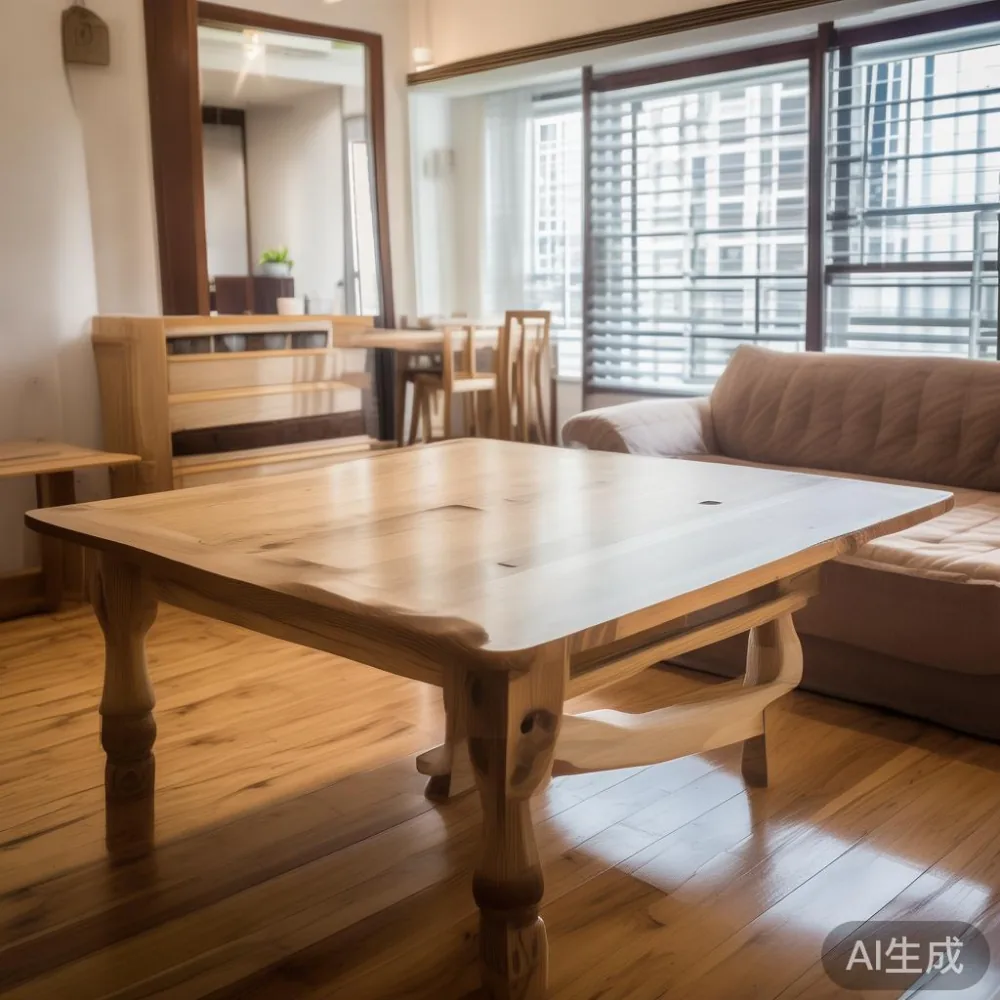
Now the dining table. A 1.6 m veneer dining table seats six and costs about SGD 350 to SGD 520. A solid oak dining table of the same length, made by a workshop running post-modern light luxury lines with softened chamfered edges, sits at SGD 780 to SGD 980. Over five years, the veneer table usually warps at the centre seam in year two, requires a clamp-and-glue repair of about SGD 160, and gets replaced in year four for SGD 380. Total: SGD 540 to SGD 880. The solid oak table typically needs one refinish of the top in year three (SGD 110) and that is it. Total: SGD 890 to SGD 1,090.
The dining table is where the budget under1000 ceiling starts to push. If the buyer stretches to a marble dining table from the same workshop, expect SGD 950 to SGD 1,250 for a 1.4 m top with an oak oak rattan wicker base, but the five-year cost curve flattens further because marble needs almost no maintenance, and the oak base can be refinished indefinitely.
How do I care for a wardrobe sg in humid weather?
Wipe the wardrobe exterior once a month with a barely damp microfiber cloth, run a small dehumidifier or a silica-gel tub inside any drawer that sits against the bathroom wall, leave a 5 cm clearance behind the wardrobe so air can move, and apply paste wax twice a year on solid wood panels so the grain does not drink in any standing moisture.
That single sentence is the answer most Singapore buyers actually need. Most warping I have seen on HDB wardrobes in Tampines came from a wardrobe pushed flush against the bedroom wall with zero airflow behind it, which then wicked moisture up from the floor and softened the bottom rail. Lift the back legs onto small plastic risers about 1.5 cm tall. That 1.5 cm gap saved a Punggol BTO owner I spoke with last month roughly SGD 200 in year three repair bills on a French light luxury oak wardrobe she bought from a Foshan workshop. The wardrobe looked identical to her neighbour's cheaper one. Five years in, hers was flat; hers neighbour's had peeled.
What about sofas, nightstands, and the small pieces that fill a HDB?
A 3-seater solid wood sofa frame in oak, the kind a Singapore family might buy for a 90 sqm flat in Punggol, retails around SGD 750 to SGD 980 for the frame alone. Add cushions at SGD 220 and you are at the upper edge of a budget under1000 plan, which is realistic if you already own a bed frame and dining table. A similar sofa frame in veneer-faced plywood sells for SGD 380 to SGD 520. Over five years, the sofa cushion foam compresses regardless of frame, so the test is the frame. The solid wood sofa frame usually outlasts the cushions, meaning you re-upholster at SGD 280 instead of replacing at SGD 520. Net five-year saving against the veneer sofa: roughly SGD 120 to SGD 200.
The nightstand is the surprise. A 45 cm solid oak nightstand with one drawer runs SGD 140 to SGD 220, versus SGD 70 to SGD 110 in veneer. The nightstand is the piece of furniture that gets knocked, kicked, soaked with water glasses, and dragged across the floor during spring cleaning. Five-year survival rate of a veneer nightstand in a HDB is roughly 60 percent. Five-year survival rate of a solid oak nightstand is closer to 95 percent. Two replaced veneer nightstands over five years cost SGD 140 to SGD 220. One solid oak nightstand, possibly sanded once for SGD 30, costs SGD 170 to SGD 250. Almost a tie on cost, a clear win on stability.
How does the lift and corridor access in HDB change the math?
This is the question shoppers in Australia or the US do not have to ask, and it actually helps the solid wood case. HDB lift openings are typically 0.9 m wide and 2.0 m tall. Corridor turns in older blocks can be as narrow as 1.1 m. A solid oak dining table top at 1.6 m long will not fit assembled, but a flat-pack veneer top also will not fit assembled. Both arrive flat-packed, so neither has an advantage on access. The advantage solid wood has is weight. A 1.6 m oak table top weighs 38 to 45 kg, which means two movers, not one. But that weight is also the reason the top stays flat over a decade instead of cupping like the 14 kg the table.
For very narrow corridors below 1.0 m, ask the maker about split-leg dining tables with detachable tops. MIDHILL, for example, ships several dining table and marble table models with a two-piece top that bolts together in the bedroom. That detail alone can save a buyer in a 1970s Bedok block from paying an extra SGD 80 for a furniture hoist through the window, which I have seen quoted twice in the last six months.
Are there hidden five-year costs that brochures do not mention?
Three. The first is the cost of your time. A flat-pack veneer wardrobe takes a HDB couple about 6 to 9 hours to assemble, plus 2 hours to dismantle, plus 1 hour per repair visit. At an opportunity cost of SGD 25 per hour, that is roughly SGD 275 in time over five years, which a buyer often does not count. The second is the disposal fee. HDB bulky-item removal is free if you book, but a private disposal service costs SGD 80 to SGD 150 per piece, and you will usually replace the veneer wardrobe once and the veneer dining table once. The third is the resale value of your home. A solid wood dining table in the dining area of a 4-room HDB at Punggol or Tampines is a small but real selling point that an agent will photograph. Veneer tables do not get photographed.
So what is the actual five-year number, in plain SGD?
For a HDB starter set, meaning a 3-door wardrobe, a queen bed frame, a 1.6 m dining table, a nightstand, and a sofa frame, the realistic five-year ownership cost works out to about SGD 1,950 to SGD 2,400 in veneer and SGD 2,250 to SGD 2,750 in solid oak. The gap is SGD 300 to SGD 350 over five years, before counting the time and resale factors. Spread across 60 months, that is SGD 5 to SGD 6 per month, less than a cup of kopi at the void deck. For a family earning the median HDB household income in Singapore, the decision is rarely about the SGD 300. It is about which wardrobe is still flat in year six.
If you are working inside a budget under1000 ceiling for the full set, the practical move is to buy the bed frame and wardrobe in solid oak first, then add the dining table in the next promotion cycle, then the nightstand. Veneer anywhere a child is going to draw with a marker, solid wood anywhere the piece has to survive a move to a new BTO in five years. That sequence is what the Tampines family I visited last month followed, and three years on, they have not replaced a single panel.